
Electric scooters are usually sold with one simple promise when it comes to maintenance: you’ll spend less.
And on paper, that makes sense. An electric scooter doesn’t have an engine that needs oil changes, an oil filter, spark plugs or the same kind of fuel-system maintenance as a petrol scooter.
But “low maintenance” doesn’t mean “no maintenance.”
You still have tyres, brakes, suspension, electrical components and, eventually, the battery to think about. And if something goes wrong, the cost isn’t always the biggest problem. Finding the right technician or waiting for a part can sometimes be the bigger headache.
So, how much does an electric scooter actually cost to maintain in India?
We looked at the regular service costs, battery replacement, tyres, brakes, electrical repairs and the bigger five-year ownership picture to understand where the money actually goes.
Table of Contents
Is an Electric Scooter Cheaper to Maintain Than a Petrol Scooter?
Yes, routine maintenance is generally cheaper for an electric scooter than for a petrol scooter.
The biggest reason is simple: an EV has fewer engine-related components that need regular servicing.
A petrol scooter has an internal combustion engine, which means regular maintenance can include engine oil, oil filters, air filters, spark plugs and fuel-system checks. Depending on the scooter and how much you ride, these costs keep coming back throughout the year.
An electric scooter doesn’t need most of them.
There is no engine oil to replace, no spark plug to change and no carburetor or conventional fuel system to clean and tune. The electric motor and controller still need inspection, but they don’t require the same routine replacement of consumable engine parts.
For a petrol scooter, servicing can cost around ₹6,000 to ₹10,000 a year, depending on the model, usage and repairs or parts required. For someone riding around 30 km a day, that can mean several service visits every year.
Over five years, that puts routine servicing at roughly ₹30,000 to ₹50,000.
Our research puts routine EV servicing at around ₹7,500 to ₹10,000 over five years.
But there is an important distinction here.
That doesn’t mean an electric scooter will only cost ₹7,500 to ₹10,000 to maintain for five years. That figure is about routine servicing. Tyres, brakes, electrical repairs and battery replacement are separate costs.
That’s where the real ownership calculation gets interesting.
Why Does an Electric Scooter Need Less Maintenance?
An electric scooter has a much simpler powertrain than a petrol scooter.
Instead of burning fuel inside an engine, the battery supplies electricity to the motor through the vehicle’s electrical and control systems.
That removes several maintenance jobs that petrol scooter owners are familiar with.
Things an electric scooter doesn’t normally need
- Engine oil changes
- Oil filter replacement
- Spark plug replacement
- Carburetor servicing
- Conventional fuel-system cleaning
- Engine tuning
- Clutch-related maintenance
That’s a significant part of why regular EV servicing can be cheaper.
But there are still plenty of components that need attention.
Things an electric scooter still needs
- Brake inspection and replacement
- Tyre replacement
- Suspension checks
- Wheel and rim inspection
- Battery diagnostics
- Motor and controller checks
- Wiring and electrical checks
- Software or firmware updates
- General inspection and tightening
So the better way to describe an electric scooter is low maintenance, not maintenance-free.
What Is Included in an Electric Scooter Service?
A typical electric scooter service isn’t just about checking the battery.
The exact checklist depends on the manufacturer and model, but a service visit can include several mechanical and electrical checks.
Battery and electrical checks
Technicians may check the battery system, wiring, connectors, charging system and other electrical components.
EVs also need technicians who understand battery management systems, power electronics and high-voltage safety. The Automotive Skills Development Council has dedicated training for roles such as Electric Vehicle Service Technician and Electric Vehicle Service Assistant, which shows how different EV servicing is from traditional two-wheeler work.
Brake inspection
Brake pads and other brake components still wear out on an electric scooter.
Regenerative braking can reduce how much the physical brakes are used on some EVs, but it doesn’t eliminate brake maintenance.
Tyre and wheel checks
Tyre pressure, tread, punctures and overall tyre condition should be checked regularly.
The same applies to wheels and rims, particularly if the scooter is frequently ridden on rough roads or through potholes.
Suspension and steering
Suspension components don’t care whether your scooter is powered by petrol or electricity.
They still have to deal with potholes, speed breakers and uneven roads.
Motor and controller checks
The electric motor itself doesn’t require engine-style servicing, but technicians may inspect the motor, controller and related electrical systems when diagnosing a problem.
How Often Should an Electric Scooter Be Serviced?
There isn’t one service interval that applies to every electric scooter.
Manufacturers set their own schedules, and the recommended interval can depend on the model, kilometres travelled and time since the previous service.
Some electric scooters may require periodic checks every few months or after a particular distance, while others have longer intervals.
This is one area where you should follow the manufacturer’s service schedule rather than a generic EV maintenance rule.
It is also worth keeping your service records.
If your scooter is under warranty, following the manufacturer’s recommended maintenance schedule can be particularly important.
How Much Does EV Scooter Servicing Cost in India?
The answer depends on what you include under “servicing.”
If you’re talking only about scheduled inspections and routine checks, the cost can be considerably lower than maintaining a petrol scooter.
Based on our research, routine EV servicing can work out to around ₹7,500 to ₹10,000 over five years.
For a petrol scooter, routine servicing can be around ₹6,000 to ₹10,000 per year, which can add up to ₹30,000 to ₹50,000 over five years.
The reason for the difference is not that EV service centres charge dramatically less for every visit.
It’s because there are fewer recurring jobs to pay for.
There is no engine oil every few thousand kilometres. There are no spark plugs to replace. There is no conventional fuel system to clean.
That’s where much of the long-term saving comes from.
How Much Does an EV Scooter Battery Replacement Cost?
The battery is the one major maintenance expense that a petrol scooter simply doesn’t have.
Depending on the scooter, battery capacity and manufacturer, a replacement can cost roughly ₹45,000 to more than ₹1,20,000.
That’s a big range, and there is a reason for it.
A larger battery pack contains more cells and generally costs more to replace. Different manufacturers also use different battery designs, components and replacement policies.
So if you’re comparing two electric scooters, don’t just look at their range.
Look at the battery warranty and what happens if the battery needs attention after that warranty ends.
Does an EV battery need to be replaced after three years?
Not necessarily.
This is an important distinction.
A three-year battery warranty does not mean the battery will only last three years.
The Bureau of Energy Efficiency notes that EV battery warranties in India can range from around 3 to 8 years, depending on the vehicle category and manufacturer, with actual terms varying by vehicle usage.
The battery can continue to be used after its warranty period. What changes is who takes on the financial risk if a major battery problem occurs.
That’s why the warranty matters almost as much as the replacement price.
What should you check in an EV battery warranty?
Before buying an electric scooter, look at:
- Warranty duration
- Kilometre limit
- Battery health or degradation conditions
- What constitutes a warranty failure
- Whether the warranty covers the complete battery pack
- Extended warranty options
- Replacement terms
A scooter with a more expensive battery isn’t automatically a bad choice. But you should know what that potential expense looks like before you buy it.
How Much Do Electric Scooter Brake Pads Cost?
Brakes are one of those costs that apply to both EVs and petrol scooters.
A brake pad replacement can commonly cost around ₹800 to ₹1,500, depending on the scooter, parts and labour.
But brake pads aren’t the only possible brake expense.
A scooter can also develop problems such as brake rubbing, dragging, uneven braking or disc-related issues. Sometimes the fix is a simple adjustment. Sometimes a component needs to be replaced.
So while an EV can eliminate engine-related maintenance, it doesn’t eliminate normal two-wheeler wear and tear.
How Much Do Electric Scooter Tyres Cost?
Tyres are another expense that often gets left out when people compare EV and petrol scooter ownership. But in reality, there isn’t necessarily a big difference in tyre cost just because a scooter is electric.
For a regular scooter, a tyre can cost roughly ₹1,500 to ₹2,000, depending on the brand, size and model. For motorcycles, the range can be wider. A tyre may start around ₹1,800 and go up to ₹3,500 or more, especially as the size and specification increase.
The bigger difference with some electric scooters is the tyre specification and availability.
Some EVs use less common tyre sizes or specific tyre specifications. If the exact size isn’t readily available at your local tyre shop, you may have fewer options compared with a popular petrol scooter that has been using the same common tyre size for years.
There is also the question of getting the tyre changed.
Changing a scooter tyre may sound like a simple job, but EVs can have different wheel, motor and hub arrangements depending on the model. Not every local tyre shop or mechanic will be comfortable working on every electric scooter. This can make tyre replacement slightly more difficult, particularly outside larger cities where EV-specific technicians may be harder to find.
And then there is the usual wear and tear.
Tyre life depends on tyre pressure, riding style, road conditions, scooter weight, acceleration and braking habits. EV torque can also affect how power is delivered to the rear wheel, but it would be too simplistic to say that every electric scooter will automatically wear tyres faster than a petrol scooter.
Potholes and rough roads can also damage tyres and rims. In some cases, a damaged rim may need repair or replacement, adding another cost to what initially looked like a simple tyre change.
So the tyre itself isn’t necessarily an EV premium. The bigger issue can be finding the right tyre, getting it fitted properly and dealing with availability for less common sizes.
For a long-term ownership calculation, tyres should therefore be treated as a separate cost rather than simply assuming that EV maintenance means everything will be cheaper.
What About Rims, Suspension and Other Wear Items?
Not every maintenance expense is specific to the electric drivetrain.
Rims can get damaged by potholes. Suspension components can wear over time. Bearings, cables, switches and other smaller parts can eventually need attention.
These costs may not be large individually, but they add up over a long ownership period.
This is also why a five-year cost calculation is more useful than simply looking at the first year’s service bill.
A scooter might be very cheap to service in year one, but the total ownership picture can look different once you add tyres, brakes, repairs and other wear items.
What About Wiring and Electrical Problems?
Electrical faults are one of the areas where EV ownership can feel different from petrol scooter ownership.
A mechanical problem can sometimes be easy to identify and fix.
An electrical problem can be harder to diagnose.
A technician may need to run diagnostics, test different components and identify whether the problem is coming from the battery, controller, wiring, motor or another part of the system.
The part itself may not always be extremely expensive.
The bigger issue can be diagnosis and downtime.
If the required component isn’t available, your scooter could spend several days at the service centre waiting for the repair.
That brings us to one of the biggest issues around EV servicing in India.
Is EV Scooter Service Availability a Bigger Problem Than Service Cost?
In some cases, yes.
The cost of a repair is only one part of the ownership experience.
The other part is how quickly you can get the scooter back.
Petrol scooters have had decades to build a huge service ecosystem in India. Independent garages, authorised workshops and local mechanics are available across cities and smaller towns.
EV servicing is still building that ecosystem.
The skills required are also different. EV technicians need to understand battery systems, electrical safety, motors, power electronics and diagnostics. ASDC’s current training programs include dedicated EV service technician roles, and its FY 2024–25 government-funded programs trained 20,522 people across automotive skill areas, including EV diagnostics and two-wheeler servicing.
The broader EV infrastructure is expanding too. Government data reported 29,277 public EV charging stations in India as of 2025.
But charging infrastructure and service infrastructure aren’t the same thing.
You can have plenty of charging stations and still have a shortage of technicians or replacement parts in a particular city.
That’s why service availability deserves to be part of the EV ownership calculation.
A repair that costs ₹2,000 and takes one day is one experience.
The same ₹2,000 repair that leaves your scooter at a service centre for two weeks is a very different experience.
What Are the Hidden Costs of Electric Scooter Ownership?
The biggest mistake in an EV maintenance comparison is to look only at scheduled servicing.
Some costs don’t happen every few months, but they can still affect your total ownership cost.
These include:
Battery replacement: The biggest potential EV-specific expense, particularly after the warranty period.
Tyres: A normal two-wheeler expense that still needs to be budgeted for.
Brake components: Pads and other brake parts wear out regardless of the powertrain.
Electrical repairs: Diagnosis can sometimes be more complicated than a straightforward mechanical repair.
Rim and suspension damage: Particularly relevant if you’re regularly riding on rough roads.
Downtime: The financial cost of being without your scooter can be more important than the repair bill itself if you depend on it for daily commuting.
This is why saying “EV maintenance is cheap” without explaining the rest of the ownership picture doesn’t tell the whole story.
Does an Electric Scooter Actually Save Money Over Five Years?
This is where the EV argument becomes much more interesting.
An electric scooter can save money in two major areas.
The first is energy cost.
Charging an electric scooter at home can cost considerably less per kilometre than buying petrol, although the exact saving depends on electricity rates, petrol prices and the scooter’s real-world efficiency.
The second is routine maintenance.
The absence of engine oil, filters, spark plugs and other engine-related servicing can make the maintenance bill lighter over several years.
Based on our five-year calculations, owners can come out around ₹1,35,000 to ₹1,71,000 ahead compared with a petrol scooter, even after accounting for one battery replacement.
But that number comes with an important condition.
The scooter needs to behave reasonably normally.
An early battery failure can change the calculation.
Repeated repairs can change it.
A long wait for a replacement part can change the ownership experience.
So the right question isn’t simply:
“Is an electric scooter cheaper?”
The better question is:
How much could I save with an electric scooter based on the way I actually ride?
Your daily distance, electricity price, petrol price, scooter efficiency, maintenance costs and ownership period all affect the answer.
Instead of using a generic “an EV can save you money” statement, we ran a real usage scenario through Wheeloy’s EV Cost & Range Calculator.
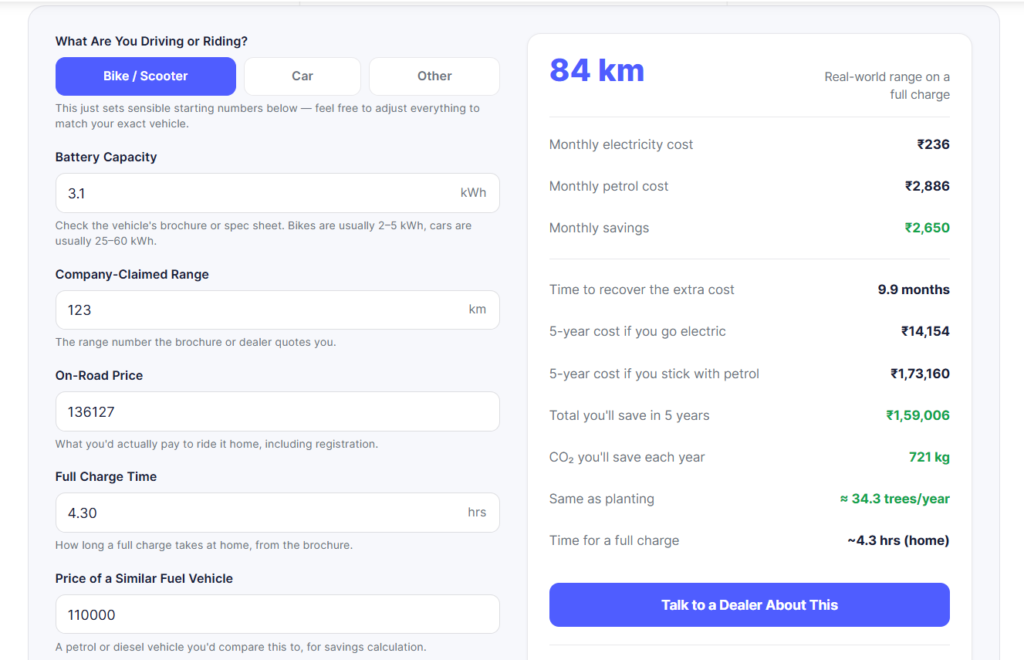
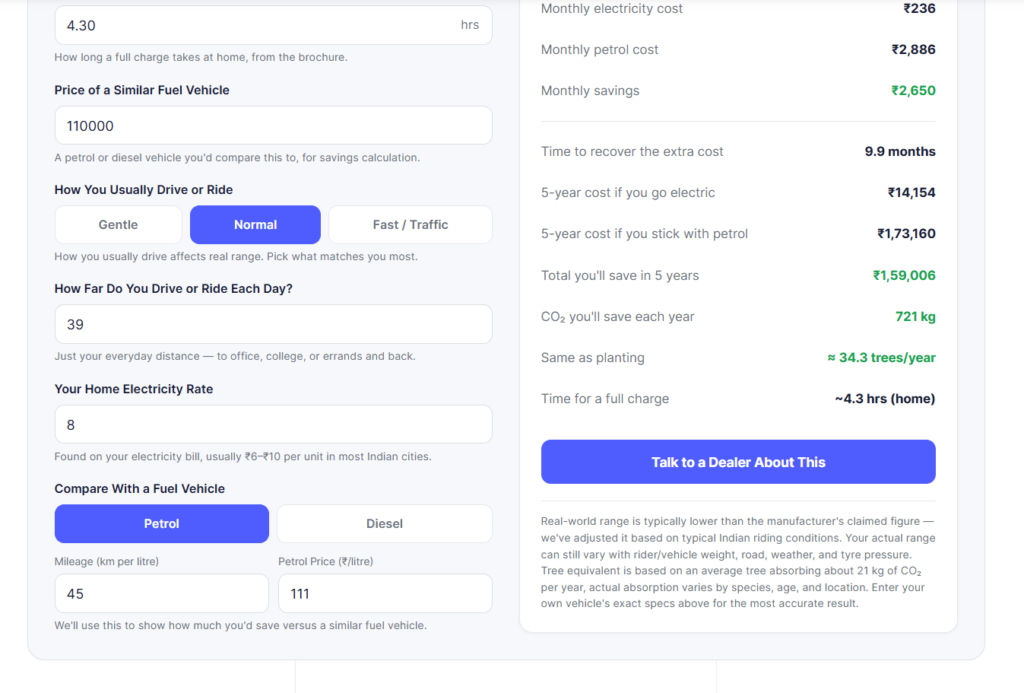
For this example, we used an electric scooter with a 3.1 kWh battery and a company-claimed range of 123 km. Wheeloy’s calculator estimates a real-world range of around 84 km under normal riding conditions.
The scooter’s on-road price in this example is ₹1,36,127, compared with ₹1,10,000 for a similar petrol vehicle.
For the usage pattern, we assumed the rider covers 39 km every day and charges the scooter at home. We used ₹8 per kWh as the electricity rate and compared it with petrol at ₹111 per litre, with the petrol scooter returning 45 km per litre.
These aren’t universal prices. Electricity rates vary depending on where you live and your household tariff, while petrol prices change by location and over time. The point is to see what the calculation looks like under one realistic set of assumptions.
The monthly difference is where it starts to show
Under these assumptions, Wheeloy’s calculator estimates the electric scooter’s monthly electricity cost at around ₹236.
The comparable petrol scooter would cost around ₹2,886 a month in fuel.
That’s a monthly difference of approximately ₹2,650.
For someone riding almost 40 km every day, that difference can add up quickly.
And this is where daily usage matters. If you only ride a few kilometres a day, your monthly saving will naturally be smaller. But when the scooter is being used regularly for commuting, the lower energy cost becomes much more noticeable.
The EV also costs more upfront
The electric scooter in this example costs ₹1,36,127, while the comparable petrol scooter costs ₹1,10,000.
So the EV has an upfront premium of around ₹26,127.
But with an estimated monthly saving of ₹2,650, Wheeloy’s calculator puts the time needed to recover that additional upfront cost at around 9.9 months.
In other words, under these assumptions, the lower running cost could make up the initial price difference in less than a year.
After that, the energy-cost saving continues to build.
What happens over five years?
This is where the difference becomes much larger.
Over five years, Wheeloy’s calculator estimates:
| Electric scooter | Petrol scooter | |
|---|---|---|
| Monthly energy/fuel cost | ₹236 | ₹2,886 |
| Five-year energy/fuel cost | ₹14,154 | ₹1,73,160 |
| Difference | ₹1,59,006 |
So, under this particular usage pattern, the electric scooter saves around ₹1.59 lakh in electricity versus petrol costs over five years.
That’s a substantial difference.
But there is an important point we shouldn’t hide.
₹1,59,006 is the energy/fuel saving shown by the calculator. It is not the complete five-year ownership saving.
Maintenance, tyres, brakes, insurance, battery replacement, repairs and other ownership costs still need to be considered.
That’s actually why this calculation is useful for our maintenance article.
It gives us a starting point.
We can see how much of the ownership difference comes simply from the cost of moving the scooter from one place to another. Then we can look at what happens when maintenance and other expenses are added.
The range difference is worth noticing too
There is another number in this example that buyers should pay attention to.
The company-claimed range is 123 km, while Wheeloy’s calculator estimates a real-world range of around 84 km.
That’s a difference of almost 39 km on a full charge.
Real-world range can vary depending on riding style, traffic, road conditions, rider weight, weather and tyre pressure. That’s why looking only at the number on the brochure can give you an unrealistic idea of how often you’ll actually need to charge.
For someone riding 39 km every day, an 84 km real-world range still gives enough range for a typical daily commute, but charging habits become important.
The calculator estimates a full home charge at around 4.3 hours.
What does this tell us?
The biggest takeaway isn’t that every electric scooter will save ₹1.59 lakh.
It is that your usage makes a huge difference to the calculation.
A rider covering 10 km a day will have a very different result from someone covering 39 km. Someone covering 50 km every day could see the energy-cost difference grow even faster.
The same applies to the vehicle itself. Battery capacity, real-world efficiency, purchase price, electricity rate and the petrol vehicle you’re comparing it with all affect the final number.
That’s why a generic statement like “EVs save money” doesn’t tell you very much.
The useful question is: how much could you save with the scooter you’re actually considering and the distance you actually ride?
That’s what Wheeloy’s calculator is designed to help you find out.
Try the Wheeloy EV Cost & Range Calculator with your own vehicle, daily distance and electricity rate to see how the numbers change.
How Can You Reduce Electric Scooter Maintenance Costs?
You don’t need to do anything complicated.
A few simple habits can prevent small problems from becoming expensive repairs.
Keep your tyres at the recommended pressure
Incorrect tyre pressure can affect handling, range and tyre wear. Check it regularly rather than waiting until the tyre looks visibly low.
Don’t ignore brake problems
If you notice rubbing, unusual sounds or a change in braking performance, get it checked.
A small brake adjustment is better than continuing to ride until another component gets damaged.
Follow the manufacturer’s service schedule
EVs need less routine maintenance, but that doesn’t mean scheduled inspections can be ignored.
Follow the manufacturer’s recommended service interval, particularly while the scooter is under warranty.
Understand your battery warranty
Know how long the warranty lasts, what kilometre limit applies and whether battery degradation is covered.
This can be worth thousands of rupees later.
Pay attention to unusual electrical behaviour
If the scooter starts showing charging issues, warning messages, sudden power loss or other unusual behaviour, don’t keep ignoring it.
Electrical problems can sometimes become harder to diagnose if you wait until the issue gets worse.
Keep your service records
Save your invoices and service history.
Apart from helping with warranty claims, it gives you a clearer picture of what your scooter is actually costing you over time.
So, How Much Should You Budget for Electric Scooter Maintenance?
There isn’t one number that works for every electric scooter in India.
Routine maintenance is generally cheaper than a petrol scooter because there are fewer engine-related components to service. That’s the easy part.
The harder part is planning for the expenses that don’t happen every few months.
For a long-term EV owner, the costs to keep in mind are:
| Maintenance cost | What to expect |
| Routine servicing | Lower than petrol in many cases |
| Brake pads | Regular wear item |
| Tyres | Regular wear item |
| Suspension/wheels | Depends on usage and road conditions |
| Electrical repairs | Less predictable |
| Battery replacement | Potentially the largest EV-specific expense |
| Service downtime | Depends on technician and parts availability |
So, is an electric scooter cheaper to maintain?
Generally, yes.
But the real advantage isn’t that every individual repair is cheaper.
It’s that you remove many of the recurring costs associated with a petrol engine.
At the same time, you take on a different set of risks, especially the battery and EV-specific electrical systems.
That’s why the smartest way to compare an EV with a petrol scooter is to look at the total cost over the period you actually plan to own it.
And that’s exactly where a calculator becomes more useful than a generic estimate.
The bottom line: Electric scooters can be significantly cheaper to maintain and run than petrol scooters, but the saving doesn’t come from having zero maintenance. It comes from removing many of the recurring costs associated with a petrol engine.
The battery, tyres, brakes, electrical repairs and service availability still matter.
So before deciding whether an EV will actually save you money, run the numbers for your scooter and your daily commute, rather than relying on a generic estimate.
Try Wheeloy’s EV Cost & Range Calculator to see what your own five-year numbers look like.
Frequently Asked Questions
-
Is electric scooter maintenance actually cheaper than petrol?
Yes. Routine maintenance is generally cheaper because electric scooters don’t need engine oil, oil filters, spark plugs or conventional fuel-system servicing.
However, EVs still need tyres, brakes, suspension checks and electrical maintenance. Battery replacement can also become a significant expense.
-
How much does an electric scooter service cost in India?
The cost varies by manufacturer, model and service centre. Based on our research, routine EV servicing can add up to around ₹7,500 to ₹10,000 over five years, excluding major repairs, tyres, brakes and battery replacement.
-
How often should an electric scooter be serviced?
The service interval depends on the manufacturer and model. Some scooters require checks every few months or after a specific number of kilometres.
Always follow the service schedule provided by the manufacturer, especially while the scooter is under warranty.
-
Do electric scooters need engine oil?
No. Electric scooters use an electric motor rather than an internal combustion engine, so they don’t need engine oil or conventional oil-change servicing.
-
How much does an EV scooter battery replacement cost?
A replacement battery can cost roughly ₹45,000 to more than ₹1,20,000, depending on the scooter, battery capacity, manufacturer and replacement terms.
-
Does an EV scooter battery need to be replaced after three years?
No. A three-year warranty does not mean the battery will stop working after three years. Battery life depends on usage, charging conditions, battery management and other factors.
The warranty period simply tells you how long the manufacturer provides the specified coverage under its terms.
-
What is the biggest maintenance cost of an electric scooter?
The battery is usually the biggest potential EV-specific expense. Tyres, brakes and electrical repairs are smaller but more frequent or unpredictable costs.
-
Do electric scooters need tyre replacement?
Yes. Electric scooters use tyres just like petrol scooters. Tyre life depends on riding style, tyre pressure, road conditions, scooter weight and other factors.
-
Are electric scooters maintenance free?
No. They are better described as low maintenance rather than maintenance-free.
They don’t need many of the engine-related services required by petrol scooters, but tyres, brakes, suspension, battery and electrical systems still need attention.
-
Is an electric scooter cheaper than a petrol scooter over five years?
It can be, particularly for people who ride regularly.
Lower energy costs and lower routine servicing costs can create significant savings over several years. Based on our research, the five-year advantage can be around ₹1.35 lakh to ₹1.71 lakh, even after factoring in one battery replacement.
The actual result depends on your scooter, daily distance, electricity and petrol prices, maintenance costs and battery situation.
-
What should I check before buying an electric scooter?
Don’t only compare range and purchase price.
Also check the battery warranty, battery replacement cost, service network, availability of spare parts, recommended service schedule and the expected running cost for your daily commute.
A scooter that looks cheaper on paper may have a very different five-year cost once all of these factors are included.

One comment
Pingback:
How to Compare Electric Scooters in India: Complete Guide