
It’s Monday morning. You’re getting ready for work. Before leaving, you unplug your EV from the charger. Whether it’s your scooter or your car, it charged to 100% overnight, just as planned.
You glance at the dashboard and see 300 km of range. That should be more than enough for the day.
You head to the office, drive the way you normally do, use the AC when it’s hot, and spend some time on the highway. By the time you’re back home, something doesn’t add up. You covered much less distance than the dashboard number led you to expect.
If that sounds familiar, you’re not doing anything wrong. Your battery probably isn’t faulty either. This is exactly why EV range is lower than advertised for almost every EV owner, and it happens everywhere, not just in India.
At Wheeloy, we spend a lot of time analyzing EV specifications and real world performance. One thing we’ve learned is that the gap between brochure range and the distance people actually drive isn’t random. It’s the result of how EVs are tested and how they’re driven every day.
The problem is that most manufacturers tell you what an EV can achieve under controlled test conditions. They don’t tell you what to expect on city roads, highways, in traffic, with the AC running, or during hot summers and cold mornings. That’s where the confusion begins.
In this guide, we’ll explain why EV range is lower than advertised, what really affects your range, and how to estimate the distance your own EV can realistically cover. No marketing jargon. No inflated claims. Just practical explanations, real numbers, and a simple formula you can use before your next drive.
Why is my EV’s real world range so much less than the brochure or official number?
It all comes down to one thing. The range printed in the brochure is measured under controlled conditions. The moment you take your EV out on real roads, traffic, weather, speed, road conditions, and your driving style all start affecting how far it can actually go.
How official EV range is tested
So, how do companies come up with those range numbers in the first place?
They don’t drive the EV through Bengaluru traffic or send it on the Mumbai-Pune Expressway. Instead, every EV goes through a standardized test in a controlled environment. The vehicle follows a fixed driving cycle, the temperature stays consistent, and there are no traffic jams, potholes, flyovers, or unexpected stops along the way.
The idea isn’t to predict how far you’ll drive on a typical Monday morning. The goal is to make sure every EV is tested under the same conditions, so buyers have a fair way to compare one model with another.
The exact test depends on where the EV is being sold. In the United States, the Environmental Protection Agency (EPA) test is used, and it’s generally considered one of the more realistic standards. In Europe and many other countries, manufacturers use the Worldwide Harmonised Light Vehicles Test Procedure (WLTP), which usually reports slightly higher range figures because it follows a different testing cycle.
Here in India, you’ll mostly come across Modified Indian Driving Cycle (MIDC) or, on some newer EVs, Indian Drive Cycle (IDC) figures. Just like EPA and WLTP, these tests are carried out under controlled conditions. They give you a common benchmark for comparing EVs, but they can’t recreate the traffic, weather, road conditions, and driving habits you’ll experience every day.
Why your everyday driving is different
The moment you leave the test track, your EV starts dealing with the real world.
Think about your daily drive. One day you’re stuck at traffic signals every few hundred metres. Another day you’re cruising on the highway. Sometimes you’re climbing flyovers, driving through heavy rain, or sitting in bumper-to-bumper traffic with the AC running the entire time. On weekends, you might even have your family and luggage in the car for a road trip.
None of these situations exist during an official range test, but they all affect how much energy your EV uses. That’s why the distance you actually cover on a full charge is usually different from the number printed in the brochure.
If you’ve driven a petrol or diesel car before, you’ve already seen something similar. A car might claim a mileage of 22 km/l, but nobody expects to get that in city traffic with the AC on. You automatically expect the real number to be lower.
EVs are no different.
The official range tells you what the vehicle can achieve under ideal testing conditions. Your real world range tells you what it can achieve on your roads, in your weather, and with the way you actually drive.
How much range should you actually expect?
There’s no single answer, since every driver uses their EV differently. But as a rough guide, real world testing generally shows EVs delivering somewhere between 10 and 30% less than their official range in everyday driving.
Where your EV falls within that range depends on several factors, including your speed, the weather, the roads you drive on, your driving style, and even how much of the battery you use before charging.
For example, if an EV has an official MIDC range of 500 km, you can realistically expect around 375 to 425 km in mixed driving conditions. If most of your driving is in the city, you’ll probably be closer to the higher end of that range. If you regularly drive on highways at higher speeds, expect the number to be lower.
The easiest way to think about it is this: the official range is a benchmark for comparing EVs, while your everyday range is what you’ll actually experience behind the wheel.
What affects your EV’s real world range?
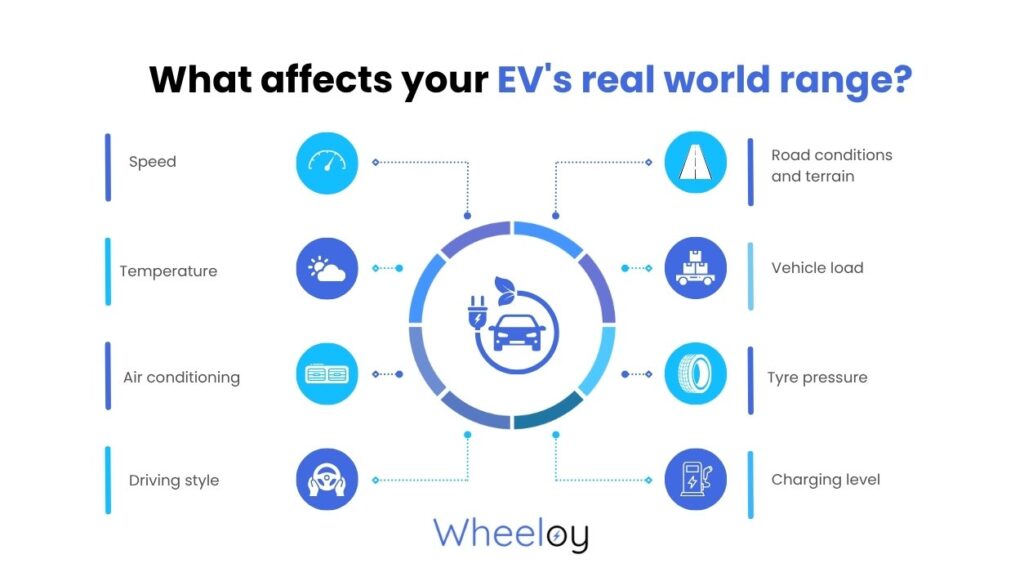
Several everyday factors influence how far your EV can actually travel.
1. Speed
Speed has one of the biggest impacts on your EV’s range.
The faster you drive, the more energy your EV needs to push through the air. That’s why you’ll usually notice the battery percentage dropping faster on highways than it does in city traffic.
Drive modes also play a role. Eco mode is designed to improve efficiency and help you get more range, while Sport mode prioritizes performance and usually uses more energy. Normal mode offers a balance between the two.
2. Temperature
EV batteries perform best in moderate temperatures.
On very hot days, your EV uses extra energy to cool the battery and keep the cabin comfortable. In colder weather, the battery becomes less efficient, and if your EV has a cabin heater running, that also uses additional power.
That’s why you may notice your EV’s range drop during extreme summer or winter conditions.
3. Air conditioning
Running the AC uses energy from your EV’s battery.
During short trips, the impact is usually small. But on longer drives, especially during hot Indian summers when the AC runs continuously, it can have a more noticeable effect on your EV’s range.
4. Driving style
How you drive has a direct impact on your EV’s range.
Smooth acceleration and gentle braking use less energy than frequent hard acceleration and sudden braking. If you drive aggressively or make repeated bursts of speed, your battery will drain faster.
Most EVs also use regenerative braking, which recovers a small amount of energy when you slow down. It’s especially effective in stop-and-go city traffic, where you brake more often.
5. Road conditions and terrain
The roads you drive on can also affect your EV’s range.
Driving uphill uses more energy than driving on flat roads. Flyovers, hilly terrain, rough roads, and stop-and-go traffic all make the battery work harder.
While regenerative braking can recover some energy when driving downhill, it won’t completely make up for the extra energy used during the climb.
6. Vehicle load
The more weight your EV carries, the more energy it needs to move.
Carrying extra passengers or a boot full of luggage won’t make a huge difference on a short drive. But on longer journeys, the extra weight can have a more noticeable impact on your EV’s range.
7. Tyre pressure
Tyre pressure can have a small but noticeable impact on your EV’s range.
Underinflated tyres create more rolling resistance, so the motor has to work harder to keep the vehicle moving. Checking your tyre pressure regularly is one of the simplest ways to maintain efficiency. It also helps improve handling, reduces tyre wear, and contributes to safer driving.
8. Charging level
Many EV owners charge their battery between 20% and 80% for everyday driving, as this can help reduce long-term battery wear.
The trade-off is that you won’t have access to the battery’s full capacity, so your available driving range will be lower than if you started with a full charge.
If you’re planning a longer journey, charging to 100% just before you leave can give you extra range, provided your vehicle manufacturer recommends it.
How can you estimate your EV’s real world range?
You don’t need any complicated tools to get a rough idea of how far your EV can travel.
A simple way to estimate it is:
Real World Range = Official Range × Expected Efficiency Factor
As a general guide:
- City driving: Around 85%–90% of the official range
- Mixed driving: Around 75%–85%
- Mostly highway driving: Around 70%–75%
For example:
- Official range: 500 km
- Mixed driving efficiency: 80%
Estimated real world range:
500 × 0.8 = 400 km
This won’t predict every trip perfectly, but it’s far more useful than assuming you’ll always achieve the brochure figure.
If you don’t want to do the calculation yourself, you can use the Wheeloy EV Range Calculator. Simply enter your EV’s battery size and claimed range, tell us how you usually ride, and it’ll show you your real world range in seconds, along with what you’d actually save each month versus a petrol or diesel vehicle.
It’s a quick way to plan longer trips and set more accurate expectations before you hit the road.
What if you only charge from 20% to 80%?
Many EV owners avoid charging to 100% every day because it can help reduce long-term battery wear.
If you start your trip at 80% and plan to recharge when the battery reaches 20%, you’ll be using about 60% of the battery’s total capacity.
For example, if your EV has an official range of 500 km, that 20% to 80% charging window works out to roughly:
500 km × 0.60 = 300 km
Your actual driving conditions will still affect this number, but it provides a realistic starting point when planning daily commutes.
Final thoughts
The official range printed in an EV brochure isn’t misleading. It’s simply measured under controlled conditions that are difficult to recreate in everyday driving.
Once you understand how official testing works and what affects battery consumption, the difference between the official range and the distance you actually drive becomes much easier to understand.
Instead of asking, “Why am I not getting the advertised range?” a better question is, “Given my driving conditions, what range should I realistically expect?”
That’s the number that really matters.

Add comment