
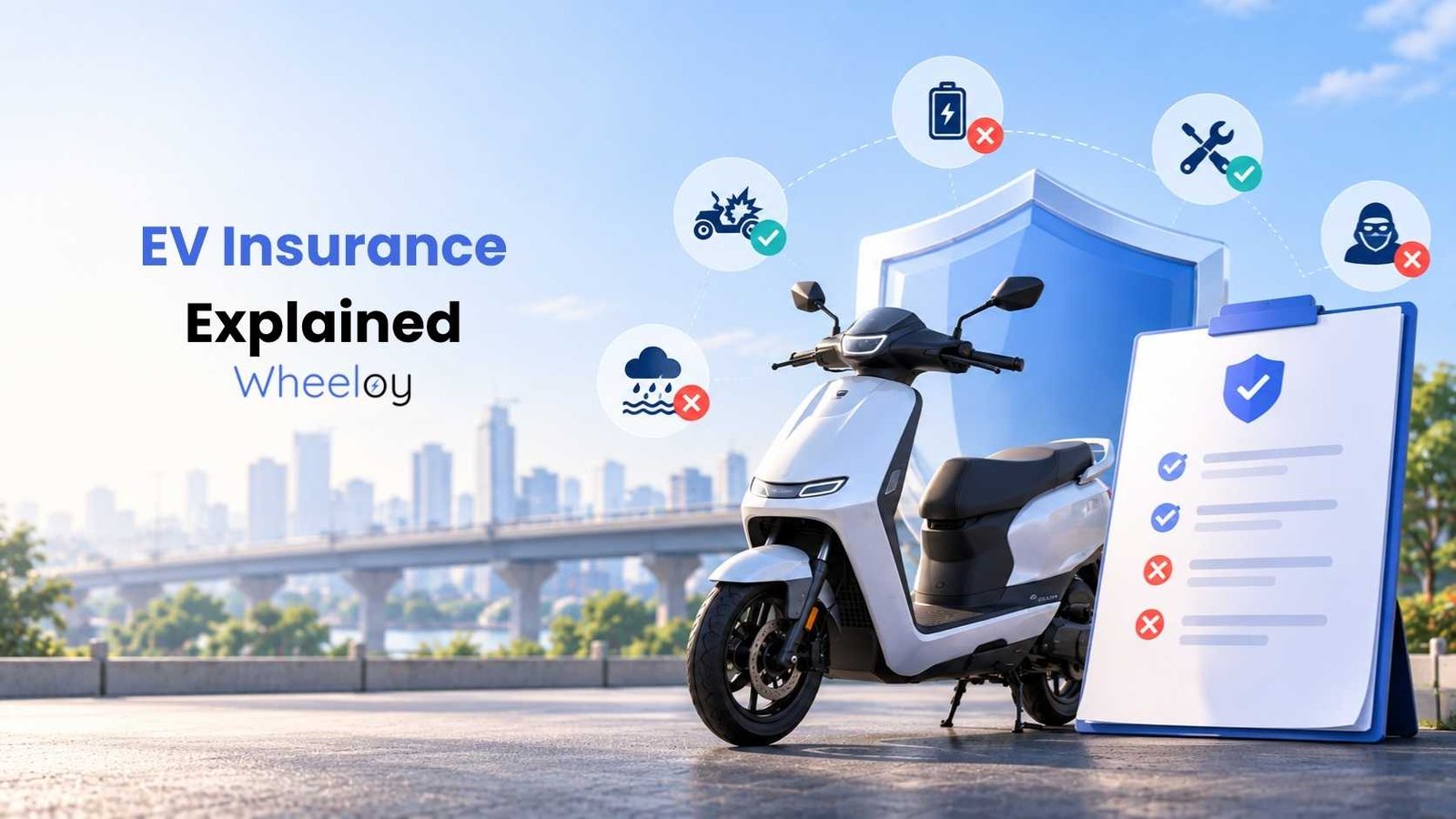
Imagine you’ve been riding your electric scooter for a year. One day, you take a road through a waterlogged stretch during the monsoon. Later, you notice a problem with the scooter’s electrical system.
You contact your service centre, get the vehicle inspected and receive a repair estimate. Naturally, you assume your insurance will take care of the bill.
But there’s a catch. Your policy may not cover every type of battery or electrical damage. Whether your claim is accepted depends on what caused the damage, the coverage you purchased and the exclusions in your policy.
This is something many buyers don’t think about when purchasing an electric scooter. They compare prices, check the range and look at charging time, but insurance often gets less attention.
The important thing to remember is that having electric scooter insurance doesn’t automatically mean every repair or battery problem is covered.
In this guide, we’ll explain how electric scooter insurance works in India, what your policy may cover, when additional protection can help and what you should check before buying or renewing your insurance.
1. Why Electric Scooter Insurance Needs a Closer Look
Electric scooters and petrol scooters both need insurance, but the components that make them work are different.
An electric scooter relies on a battery pack, electric motor, controller and charging system. Damage to these components can lead to repair bills that vary significantly depending on the fault.
The battery deserves particular attention because it can account for a substantial part of an electric scooter’s value.
For example, imagine buying an electric scooter for ₹1.3 lakh. A few years later, its battery develops a serious problem. Depending on the battery and the extent of the damage, repair or replacement could cost a significant amount.
You might expect your insurance to cover the expense, but the outcome depends on the cause of the damage and the policy terms.
An accident that damages the battery may be treated differently from gradual battery degradation or damage caused by water entering the electrical system.
That’s why understanding your insurance coverage is just as important as knowing the purchase price of your scooter.
2. What Insurance Is Mandatory for an Electric Scooter in India?
Before looking at battery protection, it’s important to understand the two main types of motor insurance.
Third-party insurance
Third-party insurance covers your legal liability for injury, death or property damage caused to another person, subject to the applicable law and policy terms.
Suppose you’re riding through traffic and accidentally hit another vehicle. If you become legally liable for the damage, third-party insurance can help cover that liability under the policy.
However, it generally doesn’t pay to repair your own scooter.
Third-party liability insurance is mandatory for electric scooters that are required to be insured under Indian motor vehicle law.
For new two-wheelers, long-term third-party cover is required. The applicable premium depends on the vehicle’s category and motor power.
One important point: third-party insurance and comprehensive insurance aren’t the same thing. Don’t assume that purchasing the mandatory cover means your own scooter is protected against damage.
Comprehensive insurance
Comprehensive insurance combines third-party liability cover with own-damage protection, subject to the policy’s terms, exclusions and deductibles.
Depending on the policy, own-damage cover may protect your scooter against specified events such as:
- Accidental damage
- Fire
- Theft
- Certain natural calamities
- Other events listed in the policy
For example, suppose your scooter falls during an accident and its body panels, suspension and battery are damaged. A comprehensive policy may cover eligible repairs, but the insurer will assess the damage and apply the relevant policy conditions.
This is why comprehensive insurance is worth considering if you want protection for your own vehicle, rather than only against liability to others.
However, comprehensive insurance still has exclusions. Battery-related damage is one area where you should read the wording carefully.
3. Does Electric Scooter Insurance Cover Battery Damage?
The answer depends on two things: what caused the damage and what your policy covers.
Let’s look at some everyday situations.
Scenario 1: Your battery is damaged in an accident
Imagine you’re riding home when another vehicle suddenly brakes. You try to avoid it, lose control and fall. The impact damages your scooter’s battery pack.
If you have comprehensive insurance, the damage may qualify for an own-damage claim, depending on the policy wording, the circumstances and any applicable exclusions or deductibles.
The important thing is to check how the battery is treated under your policy and how the insurer calculates the claim settlement.
Scenario 2: Water enters the battery system
Now imagine a different situation.
During heavy monsoon rain, you ride through a flooded stretch of road. Your scooter initially appears fine, but later it develops an electrical fault.
You take it to an authorised service centre, where the technician identifies water ingress as the likely cause.
You might assume this is covered because your scooter has comprehensive insurance. But coverage for water-related electrical damage can depend on the specific policy and any applicable add-ons.
Some policies offer additional protection for specified damage caused by water ingress. Others may exclude certain types of consequential electrical damage.
The lesson is simple: check the actual wording instead of assuming that all water damage is covered.
Scenario 3: Your battery gradually loses range
Suppose your scooter used to travel 90 km on a full charge, but after several years, you notice that it travels considerably less.
This doesn’t necessarily mean the battery has suffered an insured accident. Battery performance can decline with age, usage and charging cycles.
Normal degradation and wear are generally treated differently from sudden accidental damage.
In this situation, check your manufacturer’s battery warranty and the conditions that apply to battery health or degradation. Insurance and warranty are separate forms of protection.
4. What Is Battery Protection or EV Shield Insurance?
Some insurers offer optional battery protection or EV-specific add-ons. The name varies between products, so it’s more important to read the coverage than to focus on the label.
Depending on the policy, an add-on may cover specified damage arising from:
- Water ingress
- Short circuits
- Electrical surges during charging
- Certain damage to the battery or electric motor
- Damage to specified charging equipment
Not every add-on covers all these risks. Some have conditions, limits or exclusions, and some cover only particular components.
Before purchasing one, check the following.
Which components are covered? Does the protection apply only to the battery, or does it include the motor, charger and charging cable?
Which causes of damage are covered? Look for explicit wording about water ingress, short circuits and charging-related electrical faults.
Are there claim limits? Check whether the insurer limits the amount payable or the number of claims.
Do you have to pay part of the bill? A deductible or co-payment may apply even when the claim is accepted.
Are there specific conditions? Some policies may require authorised servicing, approved charging equipment or compliance with manufacturer instructions.
For example, if you’re considering an add-on because you regularly ride during the monsoon, check whether it actually covers the type of water-related damage you’re concerned about.
Don’t buy it based only on the words “battery protection” in the product description.
5. Is Zero Depreciation Enough to Protect Your Battery?
Not necessarily. Zero-depreciation cover and battery protection serve different purposes.
When an insurer settles an eligible own-damage claim, depreciation on certain replaced parts may reduce the amount paid. A zero-depreciation add-on can reduce or waive those deductions for eligible parts, subject to the policy terms.
But it doesn’t automatically cover every component or every cause of damage.
Imagine your scooter’s battery is damaged and you have zero-depreciation cover. You might expect the entire replacement cost to be paid.
However, you still need to establish whether the damage itself is covered. The insurer may also apply specific battery-related terms, deductibles or limits.
Before relying on zero depreciation, check:
- Whether the battery is included in the add-on
- Whether battery depreciation is treated separately
- Whether any payout limits apply
- Whether the cause of damage is covered
- Whether a separate battery protection add-on is required
Zero depreciation doesn’t mean zero exclusions.
It can be useful for reducing depreciation deductions on eligible claims, but it isn’t a substitute for checking the policy’s coverage.
6. How Much Does Electric Scooter Insurance Cost?
There isn’t one fixed price for electric scooter insurance in India.
Your premium depends on factors such as the vehicle’s value, motor power, age, location, selected coverage, applicable discounts and optional add-ons.
It’s useful to separate the cost into two parts.
Third-party insurance cost
Third-party premiums depend on the applicable vehicle category and prescribed rates.
Electric vehicles have received a discount on third-party premium rates under government rules. However, the applicable rate should be checked when purchasing or renewing a policy, rather than relying on an old estimate.
Also remember that the third-party premium is only one part of the total insurance cost.
Comprehensive insurance cost
The own-damage portion is priced separately and may vary between insurers.
Optional covers such as battery protection and zero depreciation can increase the premium. Whether they are worth paying for depends on what they cover, how much they cost and the protection already included in your base policy.
Let’s say you receive two quotes for your electric scooter.
| What to compare | Policy A | Policy B |
| Total premium | Lower | Higher |
| Own-damage cover | Check terms | Check terms |
| Battery-related protection | Check coverage | Check coverage |
| Deductible | Check amount | Check amount |
| Claim limits and exclusions | Review wording | Review wording |
The table is a comparison framework, not a claim that one policy will always be better than the other.
The cheaper policy might be sufficient for your needs. Or the slightly more expensive one might provide useful additional protection.
Compare the coverage and exclusions alongside the premium, not just the final price.
7. What Should You Check Before Buying or Renewing?
Before paying for a policy, review these details.
| What to check | Why it matters |
| Third-party cover | Protects against covered liability to others |
| Own-damage cover | Protects your scooter against specified insured events |
| Battery protection | Shows whether specific battery risks are included |
| Water-ingress cover | Clarifies whether specified water-related damage is covered |
| Charging-related faults | Helps you understand cover for certain electrical faults |
| Zero depreciation | Explains how depreciation deductions are handled |
| Insured declared value (IDV) | Affects the insured value and certain claim settlements |
| Deductible or co-payment | Shows how much you may need to pay yourself |
| Charger and cable protection | Clarifies whether charging equipment is included |
| Claim conditions | Explains the process and requirements for making a claim |
Also check whether repairs must be carried out at an authorised workshop, whether you need prior approval and what documents are required for a claim.
If you’re renewing an existing policy, don’t assume its terms remain unchanged. Review the new policy wording and compare the premium, insured value and add-ons with your previous policy.
8. What Should You Do If Your Electric Scooter Battery Gets Damaged?
If you suspect battery damage, don’t try to open or repair the battery yourself. If you notice unusual heat, smoke, swelling or other signs of an electrical fault, keep your distance, follow the manufacturer’s safety instructions and seek appropriate assistance.
For an insurance claim, follow these steps.
Step 1: Notify your insurer. Report the incident promptly and follow the reporting requirements in your policy.
Step 2: Document the damage. If it’s safe to do so, take photographs and keep relevant bills and records.
Step 3: Get the scooter inspected. Use an authorised service centre if required by your policy or manufacturer. Keep the diagnostic report and repair estimate.
Step 4: Check before authorising repairs. The insurer may need to inspect the vehicle or approve the repair before work begins.
Step 5: Review the coverage. Check whether the cause of damage and the affected component fall within your policy or add-on.
Step 6: Keep the documents. The insurer may request the policy details, vehicle information, repair estimate and other supporting evidence.
Remember, purchasing an add-on doesn’t guarantee that every claim will be approved. The insurer will assess the circumstances and apply the policy terms and exclusions.
9. Why Insurance Matters When Calculating Ownership Costs
When comparing electric scooters, most buyers focus on the purchase price and the money they could save on petrol.
But the purchase price is only the beginning.
You also need to consider electricity, routine servicing, tyres, insurance and unexpected repairs. Battery-related expenses can be particularly important because the battery is a major component of the vehicle.
Imagine two buyers purchase electric scooters at similar prices. One chooses insurance based only on the lowest premium. The other spends a little more time checking the coverage and discovers that an add-on offers protection against a specific risk that matters to them.
That doesn’t automatically make the second buyer’s policy better. The value depends on the add-on’s terms, the premium and the risks involved.
But the second buyer at least understands what they’re paying for.
That’s the point of checking insurance before buying. You’re not trying to eliminate every possible expense. You’re trying to understand which expenses may be covered and which ones you could have to pay yourself.
For a broader look at ownership expenses, read our guide to electric scooter maintenance costs in India.
The Bottom Line
Electric scooter insurance isn’t just about finding the lowest premium. It’s about understanding what protection you’re buying.
Start with the mandatory third-party cover, then consider whether comprehensive insurance suits your needs. If you choose comprehensive cover, pay attention to battery-related terms, charging risks, deductibles and optional protection.
Don’t assume that zero depreciation covers everything. And don’t assume that every battery problem is excluded either. The actual policy wording determines the answer.
Before you buy or renew, compare the premium, insured value, exclusions and add-ons. A few minutes spent understanding the policy now can help you avoid confusion when you need to make a claim.
The best policy isn’t necessarily the cheapest one. It’s the one whose coverage you understand before you need it.
Frequently Asked Questions
Does electric scooter insurance cover battery damage?
It depends on the cause of damage and your policy. A comprehensive policy may cover battery damage resulting from certain insured events, such as an accident. Water ingress and charging-related electrical faults may require specific additional cover. Always check the policy wording.
Is zero depreciation enough to protect my electric scooter battery?
Not necessarily. Zero depreciation concerns depreciation deductions on eligible claims. It doesn’t automatically cover every cause of battery damage or normal battery degradation. Check whether the battery is included and whether specific limits apply.
Is electric scooter insurance cheaper than petrol scooter insurance?
The third-party premium rates for electric vehicles have received a discount under government rules. However, the total cost of comprehensive insurance depends on the vehicle, insurer, coverage and optional add-ons. Compare equivalent policies before deciding.
Is five-year insurance mandatory for a new electric scooter?
Long-term third-party liability cover is required for new two-wheelers in India. The applicable premium depends on the vehicle category and motor power. Own-damage cover is separate, so check the duration and terms of each part of your policy.
Does electric scooter insurance cover water damage during the monsoon?
Not automatically under every policy. Some policies offer add-ons that cover specified battery or electrical damage caused by water ingress. Read the exclusions and conditions carefully, particularly if you regularly ride in areas prone to flooding.
Should I buy battery protection for my electric scooter?
Consider the battery’s replacement cost, your existing policy, the manufacturer’s warranty, the add-on premium and the exact risks covered. Battery protection may be worthwhile if it covers risks that could otherwise leave you facing a substantial repair bill.


Add comment